27/05/2026
3D Printing Design: The Golden Rules for Successful Parts
Master DfAM (Design for Additive Manufacturing). Golden design rules: 45° overhang, mechanical tolerances, and resin hollowing. In short: Designing for 3D printing requires anticipating layer-by-layer manufacturing. This guide provides you with the geometric keys to optimize your CAD files for FDM and Resin to reduce costs and ensure reliable production.
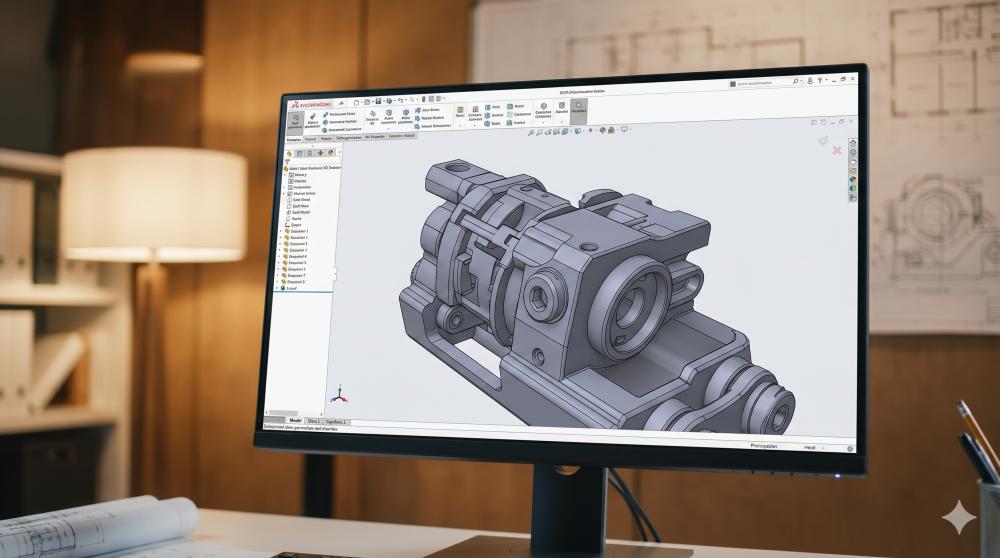
1. Mastering Angles and the 45° Rule
In 3D printing, each layer must rest on the previous one. When your model flares outwards, it's called an overhang.
- In FDM technology: As long as the angle formed with the vertical is less than 45°, the printer can deposit filament stably. Beyond this limit, the material may sag, requiring the addition of support structures that will impact the surface finish.
- In Resin technology: The issue is similar, but related to gravity during extraction from the liquid vat. A highly detailed figurine resin will require fine supports placed sparingly to avoid degrading the visual.
The DfAM reflex: Modify the geometry of your parts by replacing suspended right angles with 45° chamfers or fillets to eliminate the need for supports.
2. Anticipating Geometric Tolerances and Shrinkage
All polymers undergo thermal shrinkage as they cool or polymerize. If you are designing a mechanical assembly, designing parts to exact dimensions will lead to a blockage.
- For rigid parts (PETG, Tough Resin 2000): A minimum functional clearance of 0.2 mm to 0.3 mm is required to allow movement. Tough Resin 2000, while very precise, is no exception to this rule for engineering parts.
- For flexible materials: If you are using an elastomer like flexible TPU, tolerances can be reduced, as the inherent flexibility of the material allows for mechanical compensation of slight deviations.
3. Hollowing and Wall Thickness: FDM vs. Resin
Optimizing internal volumes is crucial for saving material and reducing costs.
- In FDM (PLA, PETG): Let the slicer software manage the infill rate. Focus on the thickness of the outer walls. To ensure good strength and limit mechanical anisotropy, plan for a wall thickness that is a multiple of the nozzle diameter (generally 1.2 mm to 2 mm minimum).
- In Resin: Large parts must be hollowed out directly in CAD to avoid trapping liquid. Absolute rule: incorporate at least two drainage holes (2 to 3 mm minimum) in non-visible areas to allow excess material to escape, a critical step before 3D printing post-processing operations.